Drywall repair in Hillsdale, NJ
Ice-dam rings on upstairs ceilings, popped nails, split seams, soaked basement walls and the holes a remodel leaves behind, patched in stages, dried between coats and textured to blend so the wall ends up ready for paint.
Call 7 days, 7am–9pm
Ring, and the return call comes from a Bergen County drywall pro who talks over the damage and builds your quote.
Decades behind the walls
At 2.94 square miles, Hillsdale is a compact corner of northern Bergen County, and its housing runs older than a drive down Broadway might suggest. Of the 3,602 homes in the borough's 2020–2024 Census survey estimates, 1,891 date from the 1950s and 1960s, more than half, while 796 predate 1940. Just 312 of today's homes were built from 1990 onward.
That age leaves a familiar set of marks. A fifties or sixties house usually has gypsum board throughout, still on its first seams and fasteners, and the studs and joists behind it have swelled and shrunk through a great many heating seasons. Pops lined up along a ceiling, a crack climbing out of a door-frame corner, tape peeling where two walls meet: those are the traces that movement leaves. In the oldest houses the wall might turn out to be plaster on lath, or plaster someone patched with board long ago, and the repair plan shifts to suit.
Nearly nine in ten Hillsdale homes are detached one-unit houses (3,118 of 3,602), and owners live in 93 percent of the occupied ones. So repairs here tend to happen in rooms people are still using. That is why the sequence of steps, the drying gaps between coats and the day a room goes back to normal all get spelled out before a date is set.
Damage type chooser
Pick whichever comes closest. The request page opens with that choice already selected, so the first phone conversation can skip ahead to size, timing and dry time.
Scale and drying schedule
Size reshapes the calendar more than anything. Joint compound needs dry time between coats, and a larger repair simply stacks up more coats, more waiting and more steps ahead of paint.
- Small
- Anything from a coin-sized dent up to a hole about as big as a fist, a short line of pops, a hairline crack. Usually a little patch or re-set fasteners, two or three skinny coats, a light sand and spot primer. Thin mud dries fastest, so a job this size can often wrap up across a day or two, humidity and compound type allowing.
- Medium
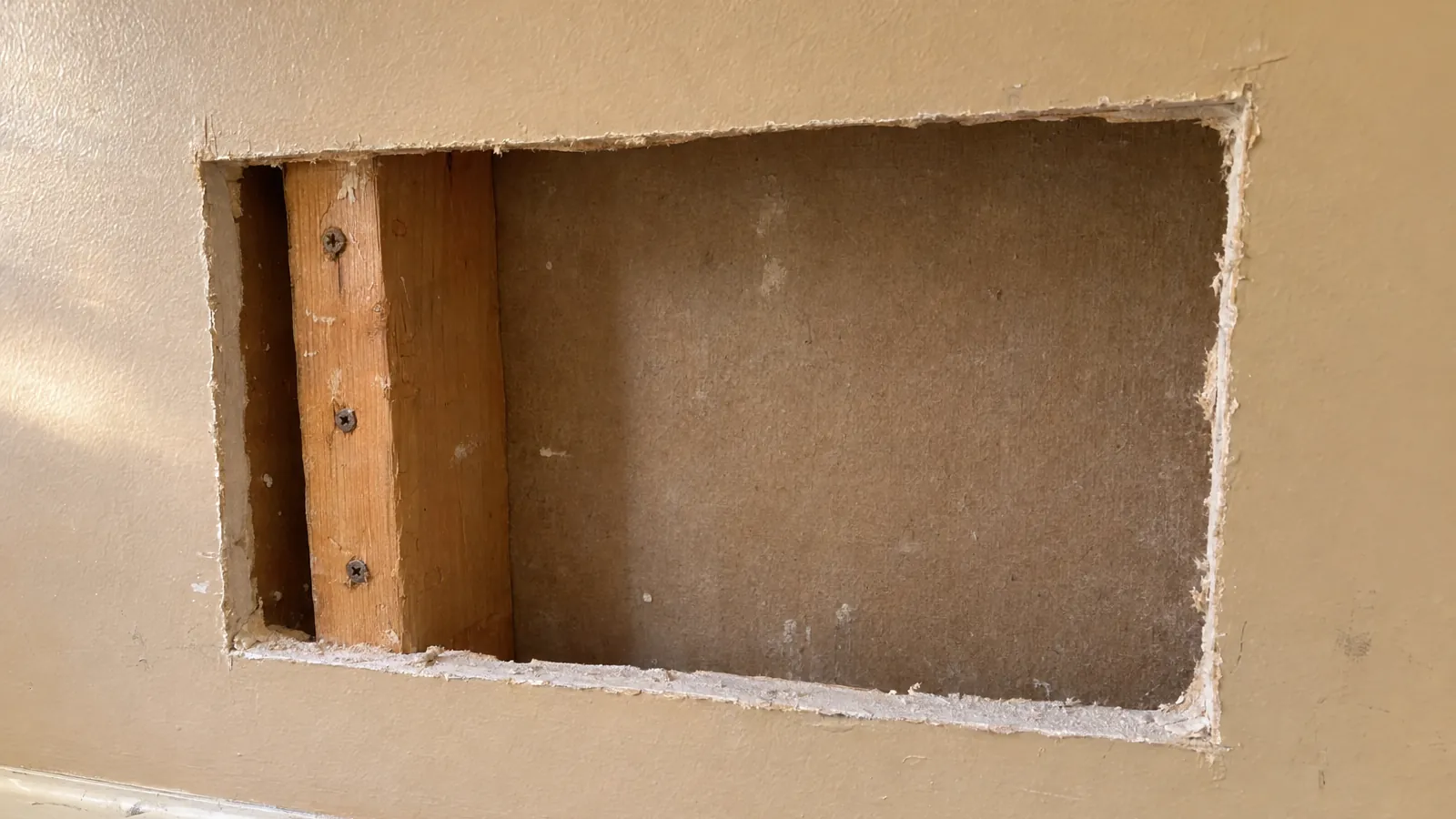
- Roughly dinner-plate holes, a split seam running across a ceiling, or the square a plumber cut out. A new section of gypsum gets screwed to studs or blocking, taped, then coated three times with drying in between. The room stays in use, though it looks half-done for a couple of days while coats cure.
- Large
- A stretch of ceiling after a leak, or a basement wall cut back after water. The framing first has to read dry. After that, soaked board is removed, replacement sheets go up, and seams get taped and coated. Bigger areas often get a thin skim over everything so old and new surfaces look like one. Work this size runs in stages, with drying windows planned in between.
No flat price fits this trade, since an identical-looking hole can mean a short job or a long one. What pushes a quote up or down: how big the opening is, ceiling versus wall, how many drying rounds the coats call for, whether texture must be copied, whether a stain needs a sealing primer, and paint-or-primer at the finish. The area pro returning your call prices it on those points before anything lands on the calendar.
Four repair specialties
These four kinds of drywall repair are what this business books in Hillsdale. Each one has a page explaining causes, sequence and what to raise when you call.
- Ice-dam ceiling repair
- Tan rings and spongy patches on upstairs ceilings after roof snow melts, then refreezes at the eaves.
- Nail pops and seam cracks
- Raised fastener heads, split tape, and cracks that widen each winter and narrow by July.
- Water-damaged drywall in basements
- Finished lower-level walls soaked by a backup, a burst line or rising groundwater, opened and rebuilt once dry.
- Patching after a remodel
- Squares and slots cut by electricians and plumbers, or a doorway that moved, closed and blended into older paint.
Workday stages and drying
This is the order a sound repair follows once it is on the calendar. Plenty of jobs skip a stage: a nail pop needs no cutting, a remodel hole needs no moisture reading. The drying stages set the overall pace.
- Room prep. Furniture slides away from the wall, and drop cloths cover the floor beneath it. If sanding is planned, plastic sheeting can seal off the doorway.
- Opening up. Damaged board gets trimmed back to solid material. Where water was involved, studs and joists get a pin-meter reading before anything is closed over.
- Board and tape. Replacement board is fastened with screws, and paper or mesh tape is bedded over the seams in compound.
- Coats and drying. Mud is applied thinly, layer upon layer, every pass reaching an inch or two past the previous edge. Every layer dries before the next, which is why a medium patch stretches past one day.
- Texture and primer. Texture gets applied to copy the surface around it, then primer evens out how paint will take.
- Dust and cleanup. Ask how sanding dust gets handled. A careful repair relies on sheeting, a sanding head connected to a shop vac, or a wet-sponge finish where that suits the patch.
How a job goes, mapped out from your opening call to the primer coat.
Pascack Valley coverage
Repairs get booked in Hillsdale and its neighbors. Westwood lies along the borough's southern edge, River Vale on its eastern side, Park Ridge directly north, Woodcliff Lake to the northwest and Washington Township to the southwest. Emerson sits one town past Westwood, and Montvale lies above Park Ridge.
Short notes on each neighbor sit on the page about towns in the Hillsdale service area.
Overhead damage
Ceilings ask for different handling than walls. Everything happens over your head, wet board sags under its own weight, and window light rakes across a ceiling so every ridge shows.
- Stains
- Rings from ice-dam leaks or from a tub upstairs that overflowed. With the leak stopped and the board solid and dry, an alcohol- or oil-based sealer covers the ring ahead of ceiling paint.
- Sagging
- Board that soaked up water or shed its nails droops between joists. Soggy sections get cut away and replaced; dry board that merely drooped can sometimes go back up with screws.
- Seam lines
- Tape that reads as a straight ridge or a crack across the room. Loose tape is sliced away, bedded again and feathered broad enough to vanish into the ceiling plane.
- Uplift cracks
- A gap where ceiling meets an interior partition, opening every winter and closing every summer. Roof framing is lifting, so the fix calls for something flexible at that corner rather than another layer of mud.
- Popcorn
- Sprayed acoustic texture, common in houses from the fifties through the seventies. Popcorn of that vintage can hide asbestos, so a chip of it heads off for testing first; repairs use a spray product made for that texture.
Weather calendar
Damage to walls and ceilings follows the seasons, and each season marks a house differently.
- Winter
- Roof snow melts over warm attic air, trickles down to the cold eaves and freezes there in a ridge. Meltwater then backs up behind that ice and under the shingles. Indoors it appears as rings close to the outer walls of top-floor rooms, sometimes weeks after the storm.
- Thaw and heavy rain
- Heavy rain has pushed the Pascack Brook past its banks around Westwood and Hillsdale more than once: in June 2011, and again on Memorial Day weekend 2022, when local reporting put the rainfall at 2.8 inches over a single day. In a finished basement, that shows up as a tide line, puffy baseboard and soft board along the bottom of the wall.
- Summer
- Muggy air slows drying, so coats need longer gaps, and lower levels stay damp. A repair set for August often needs a dehumidifier running ahead of the final coat.
- Fall
- Heating season starts, and framing dries and shrinks a touch. Seams split open, fastener heads push through paint, and cracks appear at the corners of doors and windows.
Homeowner patch limits
A few repairs make reasonable Saturday projects. One nail pop can be handled by sinking a drywall screw an inch or so beside the old nail, tapping the nail back down and skimming both dimples twice. A hole smaller than a quarter needs lightweight spackle, a sanding sponge and a dab of primer. A hairline crack inside a closet can be filled and painted. The main ingredient is patience: skinny coats, complete drying, primer ahead of paint.
The signs that a job has outgrown the weekend are fairly plain. Anything overhead larger than your palm. A stain that bleeds back through primer. Board that feels spongy, crumbles or smells musty. A crack that reopens every winter. A texture no aerosol can copies. Walls that turn out to be plaster. And anything that got wet, since board and framing both need a dry reading before the wall gets closed again.
Texture matching reference
Skip trowel, knockdown, smooth, popcorn and orange peel are each built up in their own way, and a patch blends only when it copies that method. The guide covers all five and explains how a sample is tried out on scrap ahead of the real wall. Open the guide to wall and ceiling textures.
Your next repair window
Ring the number, text in a picture, or open the request page. The conversation that follows covers how big the damage is, how much dry time it will need, and a date that suits the room.
However you reach out, you hear back from a Pascack Valley drywall pro ready to talk coats, drying and price.